INTRODUCTION
Sarah sat by her father’s hospital bed, holding his hand and whispering words she had learned as a child. The machines beeped steadily. The doctors had done their work. Now, in the quiet hours, prayer became her bridge between fear and hope.
Many people find themselves in similar moments. Illness arrives without warning. Recovery feels slow and uncertain. During these times, prayers for quick health recovery offer more than tradition. They provide emotional grounding, mental clarity, and a sense of connection to something larger than the diagnosis.
Today, millions search for spiritual support alongside medical care. They want practical guidance, not vague promises. They seek prayers that feel personal, scientifically grounded in wellness research, and easy to practice daily. This masterclass delivers exactly that.
First, we will explore what healing prayer truly means. Next, we will examine its types and benefits. Moreover, we will connect faith with neuroscience and psychology. Finally, you will leave with clear steps, reflection tools, and daily practices you can begin immediately.
TABLE OF CONTENTS
- Module 1: Foundations — What Are Prayers for Quick Health Recovery?
- Module 2: Types & Categories of Healing Prayers
- Module 3: Importance & Benefits of Spiritual Recovery Practices
- Module 4: Science, Psychology & Neuroscience of Prayer
- Module 5: Real-Life Applications & Daily Routines
- Module 6: Step-by-Step Practical Guide to Healing Prayer
- Module 7: Comparison Tables — Prayer Styles & Approaches
- Module 8: Common Misconceptions About Healing Prayer
- Module 9: Interactive Learning Activities
- Module 10: Worksheets & Reflection Prompts
- Module 11: FAQ Section — Voice Search Optimized
- Module 12: Summary & Key Takeaways
MODULE 1: FOUNDATIONS
What Are Prayers for Quick Health Recovery?
Prayers for quick health recovery are intentional spiritual practices where individuals or communities direct thoughts, words, and emotions toward physical and emotional healing. These prayers appear across cultures, religions, and personal belief systems.
Core Definition:
Healing prayer is the focused act of communicating with a higher power, universal energy, or inner spiritual center to support recovery, reduce suffering, and restore wellbeing.
Historical Background:
For thousands of years, spiritual traditions have linked prayer with healing. Ancient Egyptian texts mention temple prayers for the sick. Christian monasteries historically served as early hospitals where prayer accompanied herbal medicine. Buddhist monks practiced metta (loving-kindness) meditation for health. Indigenous communities combined ritual, prayer, and plant medicine.
Purpose in Daily Life:
Prayers for quick health recovery serve multiple purposes today:
- They create emotional stability during uncertainty
- They strengthen mental focus away from fear
- They build community support when shared with family or groups
- They provide a daily rhythm that supports medical treatment
Psychological Importance:
When illness strikes, the mind often races with worst-case scenarios. Prayer interrupts this cycle. It shifts attention from anxiety to hope. It creates a structured pause in chaotic days. Therefore, many hospitals now include chaplaincy services and quiet reflection spaces alongside clinical care.
Micro-Summary: Prayers for quick health recovery are ancient, cross-cultural spiritual practices that support emotional stability, mental clarity, and community connection during illness.
MODULE 2: TYPES & CATEGORIES
Breaking Down Major Types of Healing Prayers
1. Petition Prayers
Definition: Direct requests for healing and recovery.
Example: “Please restore my strength and heal my body completely.”
Use Case: Personal illness, praying for a hospitalized loved one.
Emotional Relevance: Expresses vulnerability and trust. Releases the burden of self-reliance.
2. Thanksgiving Prayers
Definition: Gratitude for healing already in progress or for medical care received.
Example: “Thank you for the doctors, nurses, and the healing already beginning in my body.”
Use Case: Post-surgery recovery, chronic illness management.
Emotional Relevance: Shifts focus from what’s wrong to what’s working. Gratitude reduces cortisol levels.
3. Intercessory Prayers
Definition: Praying on behalf of another person.
Example: A parent praying for a child’s recovery; a friend praying for someone in surgery.
Use Case: Community illness, family health crises.
Emotional Relevance: Builds social bonds. The person praying feels purposeful rather than helpless.
4. Meditative or Contemplative Prayers
Definition: Silent, receptive prayer focused on presence rather than words.
Example: Sitting quietly, breathing slowly, and opening awareness to healing energy.
Use Case: Anxiety management, pre-surgery calming, chronic pain.
Emotional Relevance: Reduces mental noise. Activates the parasympathetic nervous system.
5. Scriptural or Traditional Prayers
Definition: Using established prayers from religious texts or traditions.
Example: The Serenity Prayer, Psalm 23, Islamic duas for healing, Sanskrit mantras.
Use Case: When personal words feel insufficient; when tradition provides comfort.
Emotional Relevance: Connects the individual to generations of believers. Provides time-tested language for suffering.
6. Affirmative Prayers
Definition: Positive statements that declare healing as already present.
Example: “My body is strong, my cells are regenerating, my health is returning now.”
Use Case: Daily morning routine, visualization practice.
Emotional Relevance: Builds self-efficacy. Encourages a growth mindset toward recovery.
Micro-Summary: Six distinct prayer types — petition, thanksgiving, intercession, meditation, scriptural, and affirmative — offer flexible tools for different emotional needs and recovery stages.
MODULE 3: IMPORTANCE & BENEFITS
Why Prayers for Quick Health Recovery Matter
Emotional Impact
Illness triggers grief, fear, and isolation. Prayer creates a container for these emotions. Instead of suppressing anxiety, individuals acknowledge it and redirect focus. This emotional processing prevents the buildup of stress that can slow healing.
Mental Clarity
Prayer requires focus. Whether spoken or silent, it demands present-moment attention. This mental discipline clears the fog of worry. Patients who pray regularly often report better decision-making about treatment options.
Discipline Building
Daily prayer establishes routine. Routine creates predictability. Predictability reduces stress. When someone commits to morning and evening prayers for recovery, they simultaneously build habits of rest, medication compliance, and self-care.
Focus Improvement
Healing prayers train the mind to concentrate on positive outcomes. This focus improves adherence to physical therapy, dietary recommendations, and medication schedules. The spiritual practice reinforces the medical protocol.
Stress Management
Research consistently links prayer and meditation to lower blood pressure, reduced heart rate, and decreased cortisol. When the body exits fight-or-flight mode, immune function improves. Therefore, prayer directly supports the biological conditions for recovery.
Inner Stability
Health crises shake identity. A runner who cannot run. A parent too weak to cook. Prayer reconnects individuals to their deeper values beyond physical capability. This inner stability prevents depression during long recoveries.
Micro-Summary: Healing prayers deliver emotional release, mental clarity, daily discipline, improved focus, stress reduction, and inner stability — all critical factors in physical recovery.
MODULE 4: SCIENCE & PSYCHOLOGY
The Neuroscience and Behavioral Science Behind Prayer
Neuroscience Connections
Brain imaging studies reveal that prayer and meditation activate the prefrontal cortex — the area responsible for decision-making, empathy, and emotional regulation. Meanwhile, activity decreases in the amygdala, the brain’s fear center.
This means prayer literally calms the brain’s alarm system. When patients pray before surgery, they enter the procedure with lower baseline anxiety. Lower anxiety correlates with lower pain perception and reduced anesthesia requirements.
Behavioral Science Insights
Prayer functions as a positive reinforcement loop. The act of praying triggers relaxation. Relaxation feels good. The brain associates prayer with relief. Over time, this strengthens the habit. Behavioral scientists call this “reward-based habit formation.”
Moreover, prayer often includes gratitude. Gratitude practices increase dopamine and serotonin. These neurotransmitters improve mood and support immune function. Therefore, thankful prayers create biochemical conditions favorable to healing.
Mindfulness Overlap
Contemplative prayer shares mechanisms with secular mindfulness. Both practices:
- Anchor attention to the present moment
- Reduce rumination about the past or future
- Increase body awareness
- Promote non-judgmental acceptance of current conditions
Mindfulness-based stress reduction (MBSR) programs, developed by Dr. Jon Kabat-Zinn, now appear in over 700 hospitals worldwide. Many patients who resist “meditation” embrace the same practice when framed as prayer.
Habit Formation
Recovery requires consistency. Prayer, when tied to existing habits (morning coffee, evening medication), becomes a keystone habit. It anchors other healthy behaviors. Someone who prays before breakfast often remembers to take vitamins. Someone who prays before sleep often maintains better sleep hygiene.
Emotional Regulation
Prayer provides a structured way to process difficult emotions. Psychology recognizes that emotional suppression worsens health outcomes. Prayer allows safe expression. Speaking fears aloud, even in private, activates the brain’s language centers and reduces emotional intensity.
Micro-Summary: Prayer activates brain regions that reduce fear, triggers reward-based habit loops, overlaps with proven mindfulness techniques, supports keystone habit formation, and enables healthy emotional regulation.
MODULE 5: REAL-LIFE APPLICATIONS
Daily Routines and Lifestyle Examples
Daily Morning Routine
Maria wakes at 7 AM. Before checking her phone, she sits at the edge of her bed. She places one hand on her heart and breathes deeply three times. She speaks an affirmative prayer: “Today my body heals. Today my strength returns. Thank you for this new day.” She then takes her medication and drinks water. The prayer marks the transition from sleep to active recovery.
Workplace Example
James returned to work three weeks after a minor surgery. He keeps a small card on his desk with a short healing prayer. Every two hours, when his computer reminds him to stretch, he reads the prayer first. This micro-practice prevents him from overworking and ignoring his body’s signals.
Student Example
A college athlete recovering from a knee injury uses prayer before physical therapy sessions. She visualizes her ligaments healing while speaking words of gratitude for her medical team. This combination of prayer and visualization improves her compliance with painful exercises.
Family Example
The Chen family gathers each evening when their mother undergoes chemotherapy. They light a candle. Each person speaks one sentence of prayer or hope. This ritual transforms the dinner table from a space of worry into a space of collective support. The mother reports feeling less alone in her treatment.
Community Example
In many churches, mosques, and temples, prayer chains activate when someone falls ill. Members receive a text or email and pause to pray simultaneously. This network creates a felt sense of social support. Research shows that perceived social support improves recovery outcomes regardless of the prayer’s metaphysical effects.
Global and Cultural Practices
- Christianity: The laying on of hands and anointing with oil during illness
- Islam: Reading Surah Al-Fatiha and specific duas for shifa (healing)
- Hinduism: Chanting the Mahamrityunjaya Mantra for health and longevity
- Buddhism: Metta meditation directing loving-kindness toward oneself and the sick
- Judaism: Mi Sheberach prayers recited during Shabbat services for the ill
- Indigenous Traditions: Smudging, drumming, and prayer circles for community healing
Micro-Summary: Healing prayers integrate into morning routines, workplaces, student life, family rituals, community networks, and diverse cultural traditions worldwide.
MODULE 6: STEP-BY-STEP PRACTICAL GUIDE
Your Beginner-Friendly Healing Prayer Practice
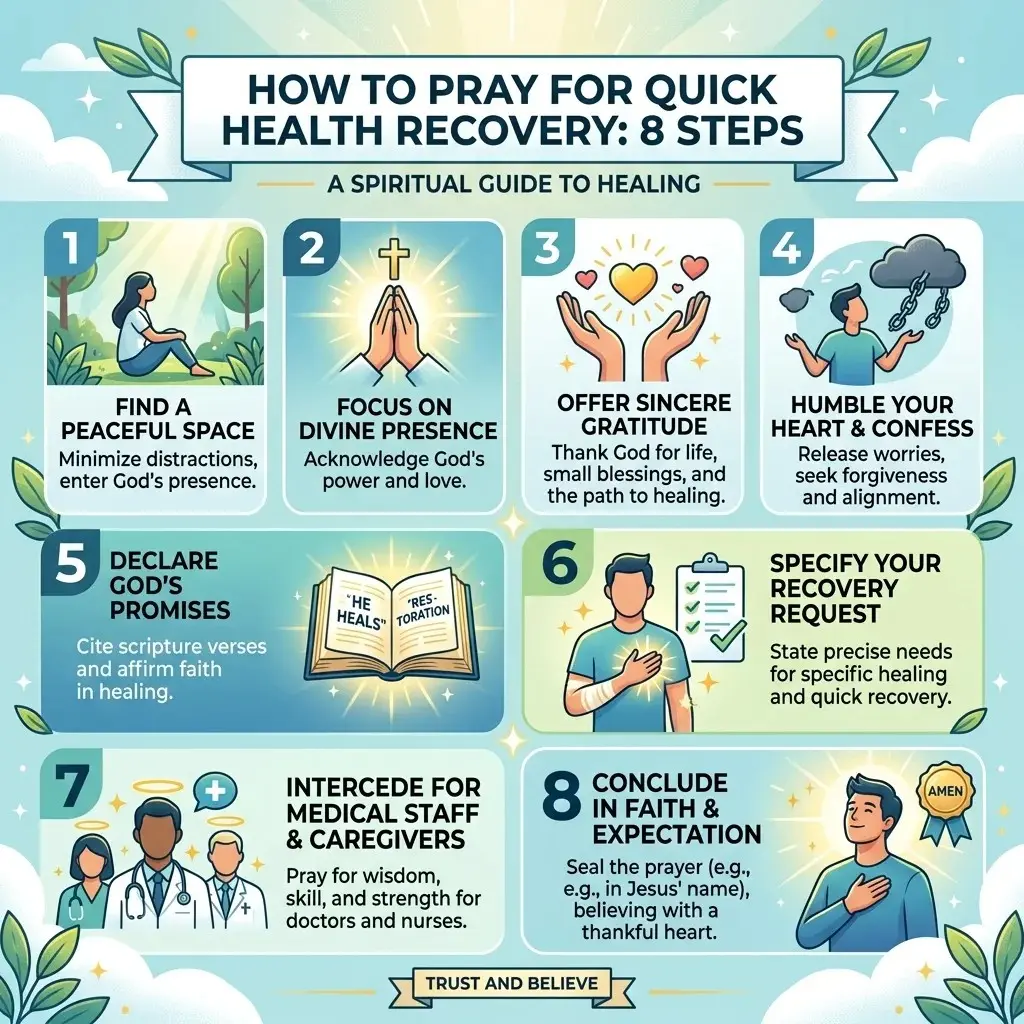
Step 1: Create a Sacred Space
Choose one consistent location. It can be a chair, a corner of your bedroom, or a spot in your garden. Keep it simple. Place a candle, a meaningful object, or a book of prayers nearby. Consistency of place trains the brain to enter a reflective state quickly.
Step 2: Set a Specific Time
Link prayer to an existing habit. After brushing your teeth. Before your morning coffee. After taking evening medication. This habit stacking ensures consistency.
Step 3: Begin with Breath Awareness
Close your eyes. Inhale for four counts. Hold for four counts. Exhale for four counts. Repeat three times. This activates the vagus nerve and shifts your body into rest-and-digest mode.
Step 4: State Your Intention Clearly
Speak directly about what you need. Avoid vague language. Instead of “Please help me,” say “Please restore my energy as I recover from this infection.” Specificity focuses the mind and creates measurable hope.
Step 5: Include Gratitude
Name three things you are thankful for right now. Even during illness, gratitude exists. “Thank you for the doctor who listened and thank you for the medication working. Thank you for my family’s presence.” Gratitude shifts brain chemistry.
Step 6: Speak or Listen
If you prefer spoken prayer, use your own words or a traditional text. If you prefer silence, sit in receptive openness. Imagine healing light or warmth moving through your body. Both approaches work. Choose what feels authentic.
Step 7: End with Affirmation
Close with a positive declaration. “I am healing. My body knows how to recover. Each day brings more strength.” This plants a constructive narrative in your subconscious.
Step 8: Journal Briefly (Optional)
Write one sentence about how you feel after praying. Over time, this creates a record of emotional progress. It also reveals patterns — perhaps morning prayer energizes you, while evening prayer calms you.
Common Mistakes to Avoid
| Mistake | Why It Hurts | Better Approach |
|---|---|---|
| Praying while multitasking | Divided attention reduces emotional benefit | Stop all other activity for 5 minutes |
| Using only desperate language | Reinforces fear and victimhood | Balance requests with gratitude and affirmation |
| Expecting instant physical results | Creates discouragement | Focus on emotional and mental shifts first |
| Praying alone when community exists | Misses social support benefits | Share your prayer needs with trusted people |
| Ignoring medical treatment | Prayer complements, not replaces, care | Follow your doctor’s protocol fully |
Best Practices
- Keep prayers short when energy is low. Quality matters more than length.
- Use physical touch. Place hands on areas needing healing during prayer.
- Record your voice reading prayers. Play them back during difficult moments.
- Combine prayer with gentle music or nature sounds if silence feels uncomfortable.
- Pray for your medical providers. This transforms anxiety about treatment into trust.
Consistency Tips
- Set a phone reminder labeled “Healing Time” rather than “Prayer” if you prefer secular language.
- Use a habit tracker app. Mark each day you complete your practice.
- Find a prayer partner. Text each other after completing daily practice.
- Forgive missed days. Guilt undermines healing. Simply resume the next day.
Micro-Summary: Eight clear steps — from creating space to daily affirmation — build a sustainable healing prayer practice. Avoid multitasking, desperate-only language, and isolation while embracing brevity, touch, and consistency.
MODULE 7: COMPARISON TABLES
Structured Comparisons for Clarity
Table 1: Silent Prayer vs. Spoken Prayer
| Feature | Silent Prayer | Spoken Prayer |
|---|---|---|
| Best For | Deep anxiety, meditation lovers, introverts | Those who process through language, extroverts, communal settings |
| Brain Effect | Increases default mode network activity (self-reflection) | Activates language centers and auditory processing |
| Speed | Can begin immediately anywhere | Requires more setup if using written text |
| Community | Typically private | Easily shared with family or groups |
| Flexibility | Highly adaptable | May feel constrained by specific words |
| Emotional Release | Gradual, contemplative | Immediate, expressive |
Table 2: Traditional vs. Modern Approaches
| Aspect | Traditional Approach | Modern Approach |
|---|---|---|
| Source | Religious texts, clergy, ancestral wisdom | Self-authored, wellness apps, integrative medicine |
| Setting | Church, temple, mosque, shrine | Hospital chapel, home altar, nature, smartphone |
| Language | Archaic or formal | Conversational, personal |
| Structure | Fixed rituals and timings | Flexible, adaptive to schedules |
| Integration | Often separate from medical care | Explicitly combined with treatment plans |
| Community | Congregation-based | Online support groups, text chains |
Table-3: Prayer Alone vs. Prayer + Action
| Element | Prayer Alone | Prayer + Medical Action |
|---|---|---|
| Physical Healing | Limited direct evidence | Strong evidence when combined with treatment |
| Emotional Benefit | Significant | Significant |
| Recovery Speed | Variable | Often faster due to compliance and reduced stress |
| Risk | Potential delay of needed care | Balanced approach |
| Recommended For | Wellness maintenance, mild illness | Serious illness, surgery, chronic conditions |
Table 4: Self-Prayer vs. Intercessory Prayer
| Dimension | Praying for Self | Praying for Others |
|---|---|---|
| Control | High — you direct your own focus | Lower — you release outcomes |
| Emotional Benefit | Empowerment, self-compassion | Purpose, connection, altruism |
| Physical Benefit | Direct stress reduction | Indirect through social bonding |
| Best Timing | Morning, before medical procedures | When loved ones are in crisis |
| Key Insight | Builds self-efficacy | Reduces helplessness in caregivers |
Micro-Summary: Comparison tables reveal that silent and spoken prayers serve different personalities, traditional and modern approaches offer distinct community structures, and combining prayer with medical action produces the strongest outcomes.
MODULE 8: COMMON MISCONCEPTIONS
Addressing Myths With Educational Clarity
Myth 1: “Prayer Replaces Medical Treatment”
Fact: Prayer complements medical care. It does not replace antibiotics, surgery, or chemotherapy. The most effective approach integrates spiritual practice with evidence-based medicine. Many major medical centers, including Johns Hopkins and Mayo Clinic, now include spiritual care departments.
Myth 2: “If Prayer Doesn’t Work, You Lack Faith”
Fact: Healing involves biological, environmental, and genetic factors beyond spiritual practice. Lack of physical recovery does not indicate spiritual failure. This myth causes harmful guilt. Prayer always provides emotional and relational benefits, even when physical outcomes differ from hopes.
Myth 3: “Only Religious People Can Pray for Healing”
Fact: Prayer transcends formal religion. Agnostics can direct intentions toward universal energy. Atheists can use prayer-like contemplation focused on inner resilience. The psychological benefits of focused intention and gratitude apply universally.
Myth 4: “Healing Prayer Must Be Long and Complex”
Fact: Brief prayers carry full emotional weight. A two-minute sincere prayer often surpasses a thirty-minute distracted recitation. Jesus’s shortest prayer was a single sentence. The Buddha taught momentary mindfulness as sufficient.
Myth 5: “You Must Pray in a Special Language”
Fact: Higher power, if it exists, does not require specific vocabulary. Praying in your native language, with your authentic voice, holds equal or greater value than archaic formulas. Emotional sincerity matters more than linguistic style.
Myth 6: “Group Prayer Is More Effective Than Private Prayer”
Fact: Both hold value. Group prayer builds community support. Private prayer builds personal discipline. Neither is superior. The best practice includes both — private daily prayer plus occasional communal support.
Micro-Summary: Six common myths — about replacing medicine, faith requirements, religious exclusivity, length, language, and group superiority — dissolve under factual examination. Prayer complements medicine, welcomes all, values brevity, and works both privately and communally.
MODULE 9: INTERACTIVE LEARNING ACTIVITIES
Reflection Exercises and Daily Tracking
Activity 1: The Five-Minute Healing Pause
Set a timer for five minutes. Sit comfortably. Close your eyes. Breathe slowly. Ask yourself three questions:
- What part of my body needs attention today?
- What emotion am I carrying about my health?
- What single word represents how I want to feel?
Then speak or think a prayer using that word. Example: If your word is “peace,” pray for peace to fill your body and mind.
Activity 2: Gratitude Mapping
Draw a simple body outline on paper. Inside it, write three things your body does well right now. “My heart beats without instruction.” and lungs bring me oxygen.” “My skin heals its own cuts.” Write a prayer of thanks for each function.
Activity 3: Prayer Partner Connection
Text one person today. Share one sentence: “I am praying for my health recovery. Will you join me for one minute at noon?” At noon, both pause. This creates accountability and community.
Activity 4: Emotional Weather Report
Before praying, describe your internal weather. “Today I feel stormy — lots of anxiety.” Or “Today feels cloudy — low energy but stable.” After praying, describe any shift. “Now the storm has softened to rain.” Track this for seven days.
Activity 5: Sacred Space Design
Sketch or photograph your ideal prayer space. It need not be elaborate. A chair plus a plant. A windowsill with a stone. Implement one element this week. Notice if the dedicated space increases your consistency.
Daily Tracking Exercise
Create a simple chart:
| Date | Morning Prayer (Y/N) | Evening Prayer (Y/N) | Mood Before (1-10) | Mood After (1-10) | One Insight |
|---|---|---|---|---|---|
| Day 1 |
Track for 14 days. Patterns will emerge. You may discover that morning prayer boosts energy more than evening prayer, or vice versa.
Micro-Summary: Five interactive activities — the healing pause, gratitude mapping, prayer partner connection, emotional weather reports, and sacred space design — transform passive reading into active practice.
MODULE 10: WORKSHEETS
Fill-in-the-Blanks and Reflection Prompts
Worksheet 1: My Personal Healing Prayer Template
Complete the following:
“Today I ask for healing in my _ (body part or condition).
I feel _ (current emotion) about this illness.
I’m grateful for _ , _ , and _ .
I affirm that my body is _ and I release fear about _ .
I welcome _ into my recovery.
Thank you for _ .”
Worksheet 2: Short-Answer Reflection
- What does healing mean to you beyond physical recovery?
- Who in your life models healthy spirituality during illness?
- What prevents you from praying consistently?
- How might your recovery change if you felt spiritually supported daily?
- What one step can you take today to integrate prayer into your healing?
Work-sheet 3: Critical Thinking Prompts
- Compare prayer to meditation. How are they similar? How do they differ for you personally?
- If a friend said “prayer is just a placebo,” how would you respond respectfully using the science from Module 4?
- Why do you think hospitals increasingly employ chaplains and spiritual care coordinators?
- Reflect on a time when prayer (or focused intention) changed your emotional state. What mechanisms might explain that shift?
Worksheet 4: 7-Day Prayer Commitment
“I commit to _ minutes of healing prayer daily for 7 days. My chosen time is: ___ .
And chosen place is: _ .
My chosen prayer type is: _ .
If I miss a day, I will: _ (self-compassion strategy).
At the end of 7 days, I will reflect on: _ .”
Sign and date: _
Micro-Summary: Four worksheets — personal prayer template, short-answer reflection, critical thinking prompts, and a 7-day commitment contract — provide structured tools for immediate application.
MODULE 11: FAQ SECTION
Voice-Search Optimized Questions and Answers
1. What are prayers for quick health recovery?
Prayers for quick health recovery are spiritual practices where individuals ask for, give thanks for, or meditate on physical and emotional healing. They combine faith, focused intention, and emotional processing to support wellbeing during illness.
2. Why do people pray for quick health recovery?
People pray for quick health recovery to reduce anxiety, find emotional stability, build hope, and feel connected to community or divine support. Prayer also creates daily structure during chaotic health crises.
3. How can I pray for quick health recovery effectively?
Find a quiet space. Breathe deeply. State your specific need clearly. Include gratitude. End with a positive affirmation. Practice daily, even for five minutes. Combine prayer with medical treatment for best results.
4. When should I pray for quick health recovery?
Pray in the morning to set a positive tone and before medical procedures to reduce anxiety. Pray in the evening to process the day’s challenges and anytime fear or pain intensifies.
5. Does praying for quick health recovery actually work?
Prayer reduces stress, lowers blood pressure, and improves emotional regulation. These changes support immune function and treatment compliance. However, prayer complements medical care rather than replacing it.
6. Can I pray for quick health recovery if I am not religious?
Yes. Focused intention, gratitude practice, and contemplative silence produce similar psychological benefits regardless of religious belief. You can direct your thoughts toward universal energy, inner wisdom, or simply healing itself.
7. What is the best prayer for quick health recovery?
The best prayer is one that feels authentic to you. It may use traditional language from your faith, or personal words that express your specific hopes. Sincerity matters more than formula.
8. How long should I pray for quick health recovery?
Five to ten minutes daily provides significant benefit. Brief, focused prayers outperform long, distracted ones. When energy is low, even one minute of intentional prayer helps.
9. Can someone else pray for my quick health recovery?
Yes. Intercessory prayer builds social support. Knowing others pray for you reduces loneliness and helplessness. Studies show that perceived social support improves recovery outcomes.
10. Should I stop medical treatment and only pray?
No. Prayer works best alongside evidence-based medical care. Major medical centers integrate spiritual support with clinical treatment. Never delay or replace necessary medical intervention with prayer alone.
11. What Bible verses help with quick health recovery?
Popular verses include Jeremiah 30:17 (“I will restore you to health”), Isaiah 41:10 (“Do not fear, for I am with you”), Psalm 147:3 (“He heals the brokenhearted”), and James 5:15 (“The prayer of faith will save the sick”).
12. How do I start a daily prayer routine for health recovery?
Link prayer to an existing habit like morning coffee or evening medication. Use a simple written prayer. Set a phone reminder. Start with just three days. Forgive missed days without guilt.
Micro-Summary: Twelve FAQ items cover definition, motivation, methods, timing, effectiveness, inclusivity, best practices, duration, intercession, medical integration, scripture references, and routine building.
MODULE 12: SUMMARY & KEY TAKEAWAYS
Concise Recap and Thoughtful Closure
Key Insights
- Prayers for quick health recovery are ancient, cross-cultural practices that support both emotional and physical wellbeing.
- Six prayer types — petition, thanksgiving, intercession, meditation, scriptural, and affirmative — offer flexible tools for different needs.
- Scientific research confirms that prayer and meditation reduce stress hormones, lower blood pressure, and improve immune markers.
- Prayer works best as a complement to medical treatment, not a replacement.
- Daily consistency matters more than length. Five focused minutes outperform thirty distracted minutes.
- Community prayer builds social support, which independently improves health outcomes.
- Anyone can practice healing prayer, regardless of religious background.
Practical Reminders
- Create one dedicated prayer space in your home.
- Stack your prayer habit onto an existing daily routine.
- Use the fill-in-the-blank prayer template from Module 10.
- Track your mood before and after prayer for two weeks.
- Share your prayer needs with at least one trusted person.
- Combine breath awareness with your spoken or silent practice.
- End every prayer session with gratitude and affirmation.
Encouragement for Reflection and Consistency
Recovery rarely follows a straight line. Some days bring energy. Others bring setbacks. Your prayer practice can remain steady even when your body fluctuates. Think of prayer as an anchor, not a sail. It does not control the wind. It keeps you stable while the wind changes.
Begin today. Not with perfection. With presence. Speak your honest words. Breathe slowly. Trust the process. Your body holds remarkable healing wisdom. Prayer simply creates the emotional and mental conditions where that wisdom can work most freely.
May your recovery be gentle and helps your spirit stay strong. May you find peace in the practice itself. For a video, click here.